
Car park data: everything you need to know
Information and insight are powerful tools for businesses. Invaluable data can come from a variety of sources such as sales, surveys, and your website. Information can come from sources you might not expect, and a car park can tell you more about your business, customers and performance than you might have realised.

Where does your data come from?
Every element of your car park can provide insight, it just needs the right tools to identify and interrogate that data.
Automatic Numberplate Recognition gives you access to an incredible amount of data that you can use to understand who is using your car park, how, and the impact this is having on your wider business.
Millions of people travel and park every day, and the insight this generates can help your business to make smarter decisions about promotion, management, staffing, investment and more.

Understanding your insights (and how to use them)
Car park data can be generated in several ways, whether that’s the insights tied into vehicle registrations or the information that you glean from payment systems. This all tells you about who is using your site and how.
Payment and Revenue
There are multiple ways for visitors to your site to pay for their parking. Whether that’s a traditional payment kiosk, card, contactless, pre-booking, or a parking app.
You want your paid parking to generate revenue, this data lets you know if your site is performing well, when the quieter days for revenue are, and most importantly which payment methods are the ones that are generating results and which are being left behind.
These insights help your car park and your business in several ways.

- Maximise the opportunities that higher performing options provide. For example, if app-based payments are increasing, you could consider introducing pre-booking as a solution to boost that revenue and provide an additional service to customers and guests.
- Remove underperforming or unnecessary payment options from your car park. This helps modernise your payment portfolio and move with changing visitor and user requirements.
- Save money by removing the unnecessary overheads keeping aging or ineffective systems in place. This helps to modernise your car park and match the needs of your visitors.
- Understand when your peak revenue-generating times are, this could influence offers, inform staffing and underpin management decisions elsewhere in the business.
Revenue is vital to a car park, getting your paid parking solutions right, and aligned with how your car park is being used, can provide a huge boost to your bottom line.
Occupancy and Space Turnover
A full car park is often a good sign. More visitors in theory equates to more sales and greater revenue.
Occupancy data lets you track how long people are staying in your car park. This should be compared to how long people are in store or visiting your business. Ideally they match. If they don’t you might have an issue with people overstaying.
This isn’t necessarily the case in retail parks where people will be visiting multiple locations. Instead the focus should be on space turnover. This is the rate at which vehicles are entering and exiting your car park.
Ideally space turnover remains steady, meaning you constantly have available space for visitors even during busy periods.
Issues with overstaying or people parking and going elsewhere have a major impact on your ability to welcome visitors. During busy periods this can create congestion and queues across your car park that frustrate motorists, create the wrong impression of your brand and even deter customers from returning.
The major benefit of tracking activity on your site is figuring out when the peaks and troughs are. The peaks should align with upticks in sales and footfall, if they don’t you can begin to question where the people visiting your site are going.

Understanding when the troughs occur is great for staff management and planning. It allows you to position shifts to better cover the busier periods instead of having staff waiting around. It also presents opportunities, depending on the type of business’ to attract new visitors or introduce new initiatives. This could include quiet shopping hours, early-bird deals, or offers that can entice new visitors and lift footfall in quieter moments.
Those quieter moments in a car park can be turned to your advantage. The periods where you have more surplus space are prime candidates for pre-booking.
By listing those spaces that you know are going to be available, you can attract new visitors to your car park and boost revenue during moments when your site is less busy. This all helps to support your bottom line, improve footfall and potentially bring new customers through your doors.
The data helps you identify the opportunity and deliver that service in a way that doesn’t impact or overwhelm your car park during busier periods.

Visitor Data
Your visitor data can help you understand how your car park is being used. If your car park is full when your transactions are low, and the store is quiet, you might be looking at a serious parking abuse issue.
Much like with occupancy data, visitor data enables you to identify the type of visitor to your site and the peaks and troughs in the way they visit your site.
You might notice that permit holders or members mainly use your site on specific days such as gym users attending classes for instance. Armed with this data you could then begin exploring opportunities to encourage visitors on quieter days. This could mean providing deals and incentives such as free classes, bringing in new customers at quieter times or enticing members to your site more often.
Visitor data lets you gauge seasonal impact too. Attractions such as zoos, theme parks or museums can chart the uplift in visits in relation to school holidays or half-terms. Retail outlets can also see if there are uplifts in relation to sales or offers.
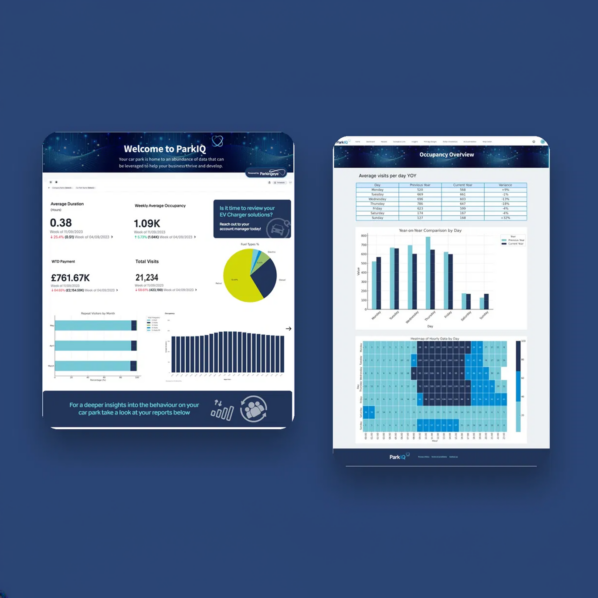
Our weekly variance tracking allows you to see how usage on your site compares from one week to the next and, once that data is in place, as a year to date figure.
Your visitor data lets you track your car park performance over time and help you generate seasonal forecasts, identifying your busiest trading periods and allowing your business to plan and prepare for them effectively.
That insight can influence multiple aspects of a business. Adjusting shifts to handle peaks, scheduling maintenance work for quieter periods, or understanding when to start promotional efforts.
Average Stay Duration
Capacity and occupancy data lets you know if you car park is being used, but stay duration is important for tracking if people are using a site in the right way.
This tracks how long people are staying on-site.
Stay duration, or dwell time is important information. It can help to identify issues with misuse.
For example, a retail outlet, you know roughly how long people spend in store. This data can be compared to the amount of time vehicles stay on the car park. The two should be similar, if they aren’t this could prompt further investigation.
If your customers aren’t spending a long time in store, but a long time on the car park, why? Are there other shops? Is it an issue with the store/customer service that needs to be addressed?
If people aren’t spending a long time on site does that correlate with instances of shoplifting?
Your car park can help you to uncover issues hampering your visitor experience and store performance. Average stay duration data can provide real insight into your space turnover (the number of times each space is used by a genuine customer).
Using this data can help you build a deeper understanding of your customers’ movements and assist you in adapting your business to meet customer needs, from improving store layout to help them move through a site more efficiently, to tightening security if your car park reveals instances of theft.

Repeat Visitor Analysis
Customer loyalty matters. Your car park can tell you how often people return to your business.
You can chart weekly and monthly visits. What this data allows you to see is the frequency of visits and subsequently helps you understand the need to introduce a loyalty scheme or track the success of current initiatives.
For example, if you launch a loyalty scheme that rewards multiple purchases, your repeat visits increasing can be a sign of the scheme being effective. Or if there is a scheme in place and minimal repeat visits you might need to rethink the approach you are taking.
This can help you increase footfall and revenue, purely by understanding how often people are returning to your site and adapting to capitalise on this information.

Fuel Analysis
ANPR tracks vehicle registration plates. A number plate contains a lot of information. Not just where a vehicle was registered, but also the type of vehicle.
That’s important for your business to understand.
The types of vehicles using a site allows you to track trends. Looking at fuel types it’s possible to track the changes in the cars visitors are driving.
As the UK moves towards being more sustainable, and increasingly moving towards electric vehicles there are increasing opportunities to invest in solutions like EV chargers.
Before you decide to invest EV however, it’s worth looking at your car park data so you understand:
- How many electric cars are using your site
- How many chargers you need to accommodate them
- The scale of EV investment needed to support growing adoption
EV charging is often a large investment for a site to make. This data is invaluable in working out the scale of investment, what a business can afford, or even putting benchmarks and milestones in place for future growth.
The fuel analysis data, coupled with stay duration and payment tracking allows you to chart the growth in EV usage on your site. Doing this allows you to track performance and the return on your investment. Meaning wider management and investment decisions can be made with complete visibility and understanding that supports your decision making.

Contraventions
ANPR is put in place to first and foremost solve problems in a car park. It’s important that you know that your car park is being protected.
Being able to track the instances of rules being broken, or issues being logged by your ANPR system are key.
This allows you to see when the issues are occurring but also the type. It might be that your car park has issues with overstaying or non-payment. This data lets you identify the problem and then adjust your car park management in order to more effectively combat those problems and keep your car park operating at its most effective.
Contravention data allows you to track new solutions bedding in and having an impact. A site with a high level of abuse and no management in place should see a large number of contraventions to begin with. Then should be able to observe that number decreasing as the solutions are introduced and start to combat the causes of poor parking behaviour.
This should be the benchmark for how successful your car park management is being, with your other data helping to identify the causes of spikes in parking problems. For example, if you notice a spike in overstaying amongst EV drivers after the introduction of new chargers that could be a strong sign to look at Bay Management as a way to counteract that and keep your chargers available for users who need them.

How data impacts decisions
Management decisions shouldn’t all be made on gut feeling. Data can guide or confirm thinking helping steer decisions in the right direction and maximise the potential of your car park.
You can use data in several ways
Management
You need to know that your car park is performing properly and that your business is maximising its ability to deliver on what its customers or guests expect. From a healthcare setting that needs to ensure effective access and a positive patient experience, to a retailer trying to drive sales, a car park is an important touchstone in a user journey.
Issues across a business and its car park reverberate, being able to spot, identify and respond to those problems quickly is crucial.
Your car park data supports management by helping to identify those issues early and make sure the right steps are taken to protect the people using your site and the benefit your car park provides to a business.

Forcasting
Planning ahead is key to setting yourself up for success.
ANPR and car park data can help to create detailed forecasts for your car park and wider business.
We can help you assess the impact that major changes to your business have had. From increasing the capacity of your car park, a competitor entering the market, amending layouts, or offering new payment methods, gaining a solid before and after picture.
Scenario analysis can provide you with a detailed overview that shows how the effects of any changes have been felt in the car park. This can also help you to predict the impact of future changes or what the impact of new or updated solutions could be.
Benchmarking
We’re able to help you understand how your site is performing in relation to your competitors and wider sector.
Benchmarking helps you to draw points of comparison, chart performance within your market, and highlight ways to improve and adapt your parking experience to better support your customers and staff.
This is analysis drawn from car park data from across our entire parking estate and allows us to analyse industry sectors and trends.
Doing this helps to keep you aware and engaged with industry changes – this could be changes to buying habits to changes in how the public manage their parking. Understanding this data allows you to remain able to adapt and ensure continually high levels of service.

Get more from your car park
At Parkingeye, we manage over 4000 car parks across the UK, dealing with millions of motorists daily.
We know what makes car parks into a powerful asset for a business. From effective enforcement and robust payment options to the data and insight a site generates, we can help you create a better car park for your visitors, customers and staff.
To discuss how we could help you transform your site and understand your car park data, get in touch using our form.